Osteosarcoma Study Participants Needed (Updated Study)
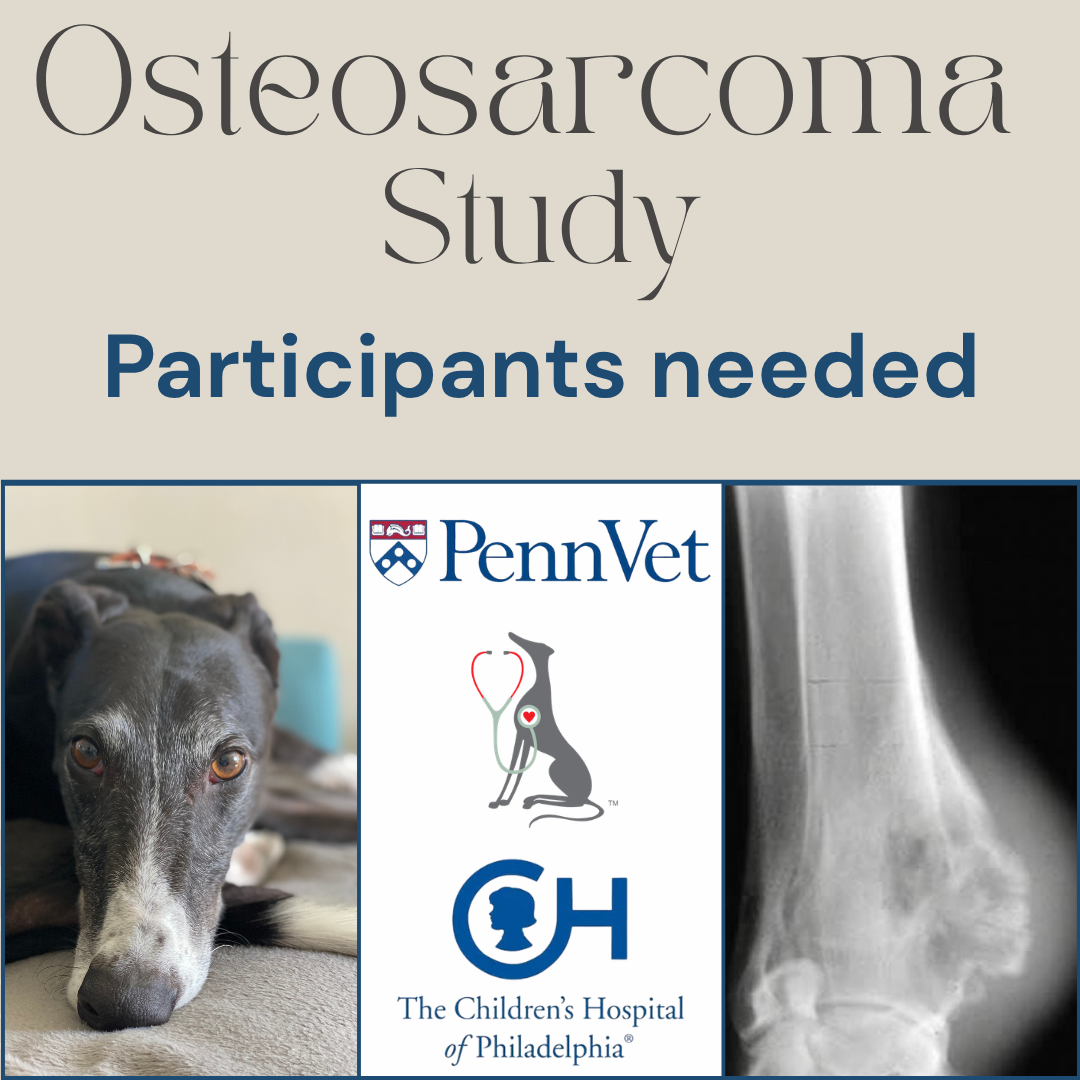
Has your dog been diagnosed with osteosarcoma and is scheduled (or soon to be scheduled) for a limb amputation? If so, you and your veterinary surgeon can participate in a collaborative study led by Nicola Mason, BVetMed, PhD at the University of Pennsylvania School of Veterinary Medicine, in partnership with researchers at the Children’s Hospital of Philadelphia (CHOP).
PennVet and CHOP are working together to advance new immunotherapeutic and precision‑medicine approaches for dogs with osteosarcoma. Fresh tumor samples collected at the time of amputation are sent to the Mason Laboratory at PennVet for initial processing. Portions of each sample then support parallel research at both PennVet and CHOP—expanding the impact of every donation and accelerating discoveries that may benefit both canine and human patients.
As an OWNER, what am I being asked to do?
- We are asking you to allow a small portion of your dog’s tumor (taken from the amputated limb) to be sent to the laboratory of Dr. Nicola Mason at the PennVet for research. Dr. Mason’s team will split a portion of the sample to send to CHOP’s research team for further research.
- We will send a tumor-collection packet to your veterinarian.
- When you arrive at the veterinarian on the day of your dog’s amputation, you will be asked to sign the consent form to allow a portion of your dog’s tumor to be sent to PennVet for further studies.
- After amputation, your veterinarian will take a small piece of tumor from the amputated limb, place it in the transport liquid and ship it overnight to the Mason lab.
- It is important to note that at this early stage, participation in this study will not provide any treatment for your dog at this time. Providing consent for sharing a portion of your dog’s tumor will not provide a new therapy for your dog but it will help us learn how we might be able to attack these tumors more effectively and might help dogs in the future with this disease. This is a very early pilot study to see if we can grow and analyze the function of immune cells from osteosarcoma tumors. We are hopeful that in the future, because of this work, there may be an option to develop a new treatment for osteosarcoma.
- This is the very first step and we need your GREYT help to get started! For more information, see the owner’s informational document below. To get started, fill out the following online form or email us at osaresearch@ghi.vet
For Vets & Owners
For more information on osteosarcoma and the research, please watch our previously recorded webinar or related articles below.
As an VETERINARIAN, what am I being asked to do?
- After performing the amputation, to collect fresh (not formalin fixed) osteosarcoma tissue for studies on living tumor cells and tumor-infiltrating lymphocytes.
- For more information on the process of collecting the sample, see video below or informational document.