Clinical trial for dogs with OSA now taking patients
In this study we will investigate the therapeutic potential of immune cells known as invariant natural killer T (iNKT) cells made from the blood of a healthy donor dog, to treat dogs with bone cancer. iNKT cells are potent immune cells that have been shown to kill cancer cells in mouse models and in some human cancer patients. iNKT cells directly kill the tumor and they also boost the patient’s own anti-tumor immune responses.

We will use iNKT cells that have been genetically modified to express a protein known as a chimeric antigen receptor or CAR. The CAR directs the genetically modified iNKT cells to target a protein known as B7H3 that is expressed on most osteosarcoma tumors. The CAR-iNKT cells kill the bone cancer cells and activate the immune system to do the same, reinforcing the effect.
 
The purpose of this study is to determine:
1) The safety of CAR-iNKT cells.
2) Their ability to traffic to the bone tumor in your dog’s leg and exert an anti-cancer effect there.
3) The ability to delay or prevent metastatic disease.
4) How long the CAR-iNKT cells remain in your dog’s body.
 
This clinical trial is fully funded and will pay for all blood work, screening, and imaging. It also will pay for amputation and standard of care chemotherapy.  All clinical trial visits are in person at the University of Pennsylvania School of Veterinary Medicine in Philadelphia, Pennsylvania
   

INCLUSION CRITERIA

  • Dogs with newly diagnosed osteosarcoma whose owners are pursuing amputation and standard of care chemotherapy.
  • Adequate heart, liver and kidney function
  • Body weight of at least 50 lbs (23 kilograms)

EXCLUSION CRITERIA

  • Osteosarcoma that has already metastasized
  • Absence of expression of B7H3 in the tumor
  • Other concurrent disease processes
 
Please contact either
Mary Beth Boland (mboland@vet.upenn.edu); 215.898.5098 or
Dr. Nicola Mason (nmason@vet.upenn.edu); 215.898.3996
 
 
For more information about the PennVet Comparative Immunotherapy Program and current clinical trials, please visit:
 
For more information about the PennVet Cancer Center and current clinical trials, please visit:


See below for additional OSA research or clinical trials:
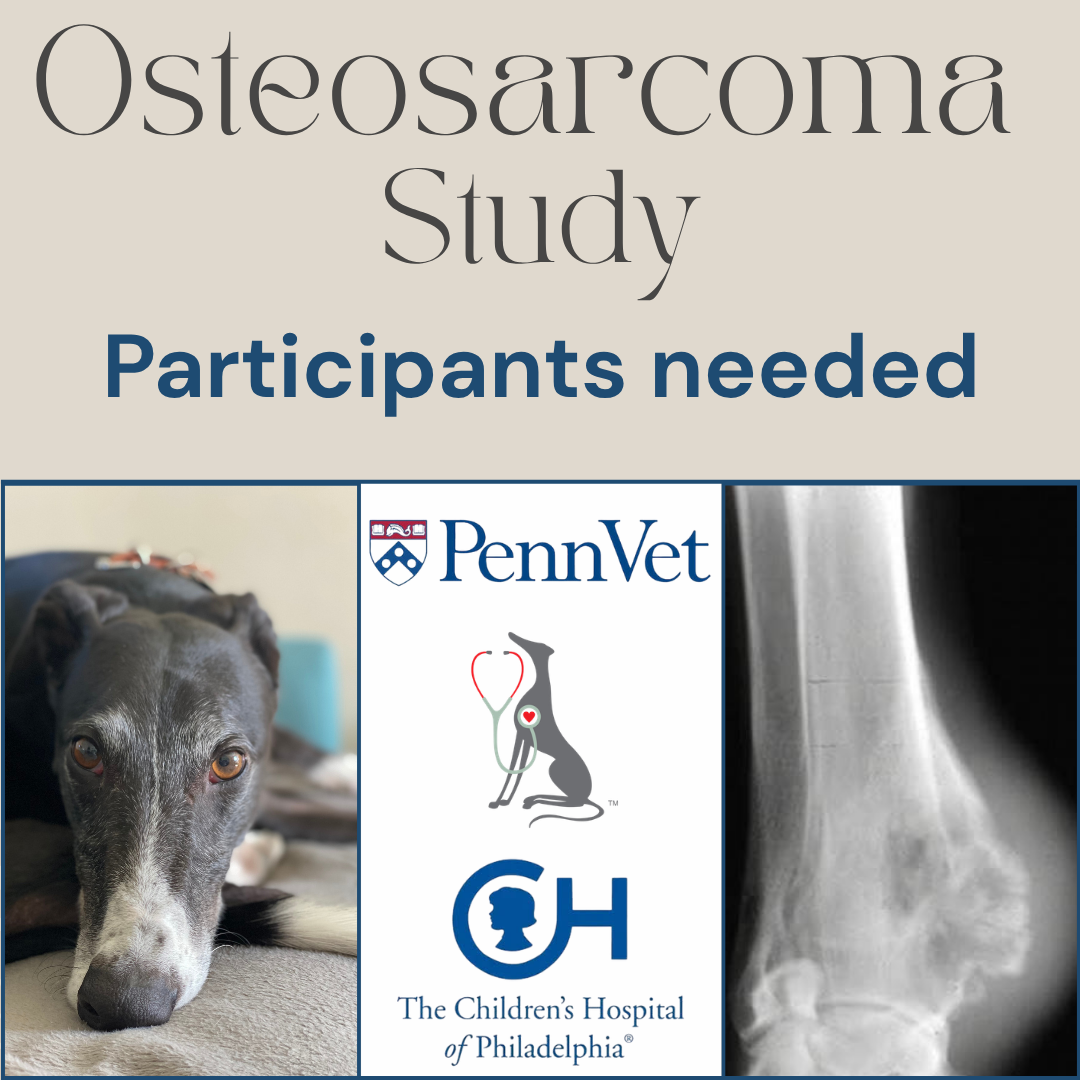
OSA Research tissue study mason
 

UPenn & CHOP research teams are exploring a new cell-based immunotherapy for dogs with osteosarcoma. Fresh tumor samples collected during amputation are needed for processing. Click here for more information on participating in this study.
OSA Biomarkers Research Info
 

This IDEXX Labs study is working to detect osteosarcoma before symptoms appear—using just a simple blood sample. If your dog has been diagnosed and you’d like to contribute to this important research, click to learn more.
Metastatic OSA clinical trial info
 

If your dog has been diagnosed with metastatic osteosarcoma, they may be eligible for a clinical trial at PennVet. This study explores a promising immunotherapy designed to slow disease progression and reduce lung metastases.


Educational Information

  • Winston Kicking Cancers Tail

    — —

  • Reno – A Trailblazer in OSA Study

    — —

  • Risk-modeling of dog osteosarcoma genome scans shows individuals with Mendelian-level polygenic risk are common

    — —

  • SETD2 Is Recurrently Mutated in Whole-Exome Sequenced Canine Osteosarcoma

    — —


Nothing Found